
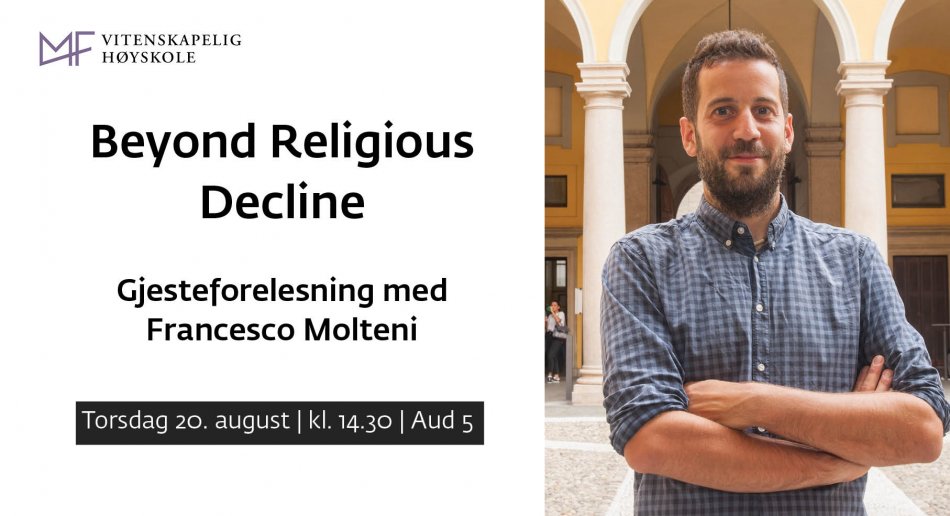
- Tid:
- Sted: Auditorium 5
- Legg til i kalender
Religionssosiologisk forskergruppe inviterer til gjesteforelesning med Francesco Molteni fra Universitetet i Milano. Tema for forelesningen er Beyond Religious Decline: Three Dimensions of Individual-Level Secularization.
Forelesningen varer i ca. 45 minutter og det åpnes for spørsmål og diskusjon i etterkant. Forelesningen holdes på engelsk og er åpen for alle. Det blir lett servering.
Om forelesningen
Across decades and theoretical traditions, multiple definitions of secularization have been proposed. From Weber’s account of rationalization and the displacement of religious and magical explanations, to Wilson’s emphasis on declining social significance, to Berger’s notion of societal differentiation from religion, and finally to multilevel approaches such as those of Dobbelaere and, in part, Casanova.
When it comes to empirical testing, a substantial body of research has focused on the decline of individual religiosity and its potential determinants. While one group of scholars argues for a generalized, cohort-driven decline in religiosity across multiple dimensions, others emphasize the transformation and individualization of religion, whereby some dimensions gain prominence while others lose relevance.
In this presentation, I argue that many of the nuances proposed by the classical theorists – such as the loss of social significance – can also be adapted to the individual level. I then propose at least three ways in which secularization can be conceptualized and, most importantly, empirically tested using individual-level data.
- Secularization as the decline in the number of people who practice, believe, and identify with a religion, representing the most standard account.
- Secularization as the declining explanatory power of religious affiliation for attitudes, values, and beliefs, focusing on whether and how religious individuals are changing over time and across generations.
- Secularization as the diminishing influence of religious practice, belief, and affiliation on attitudes, values, and beliefs, irrespective of the size of the religious population.
These three approaches will be conceptualized and synthesized, and empirical evidence will be presented using EVS/WVS data from a sample of European countries, focusing on three broad domains of attitudes and values: moral values (e.g., abortion, euthanasia, and divorce), attitudes toward immigrants, and gender attitudes.
Building on these analyses, I will also offer preliminary insights into the potential relationships among these three ways of intending of secularization. For example, a shrinking religious population may either weaken or strengthen the role of religion in explaining attitudes and values, maybe also depending on some contextual characteristics (cross-level interactions). I will finally outline the next empirical steps required to develop a more comprehensive understanding of individual-level secularization in its broader sense.
Om Francesco Molteni
Francesco Molteni er førsteamanuensis i tenure track-stilling (RTT) ved Institutt for samfunns- og statsvitenskap ved Universitetet i Milano, hvor han også er medlem av styret for doktorgradsprogrammet Network for the Advancement of Social and Political Studies (NASP). Han har doktorgrad i sosiologi og metode i samfunnsforskning.
Hans viktigste forskningsinteresser omfatter religion og religiøse endringer, overføring og sosialisering av verdier og holdninger, migrasjon og akkulturasjonsprosesser. Han arbeider hovedsakelig med storskala komparative og nasjonale surveys, og har også jobbet med fire originale datasett: BOnD, CARPE, ResPOnsE COVID-19 og COValues.
Arbeidene hans er publisert i internasjonale fagfellevurderte tidsskrifter som Social Forces, Journal of Ethnic and Migration Studies, Sociology of Religion, European Societies og British Journal of Sociology. Han har også utgitt boken A Need for Religion: Insecurity and Religiosity in the Contemporary World på forlaget Brill.
Han er prosjektleder (P.I.) for prosjektet «Between Origin and Destination (BOnD)», finansiert av CARIPLO-stiftelsen. I 2025 vant artikkelen hans «Rising security and religious decline: Refining and extending insecurity theory» prisen for beste artikkel fra International Society for the Sociology of Religion (ISSR).