
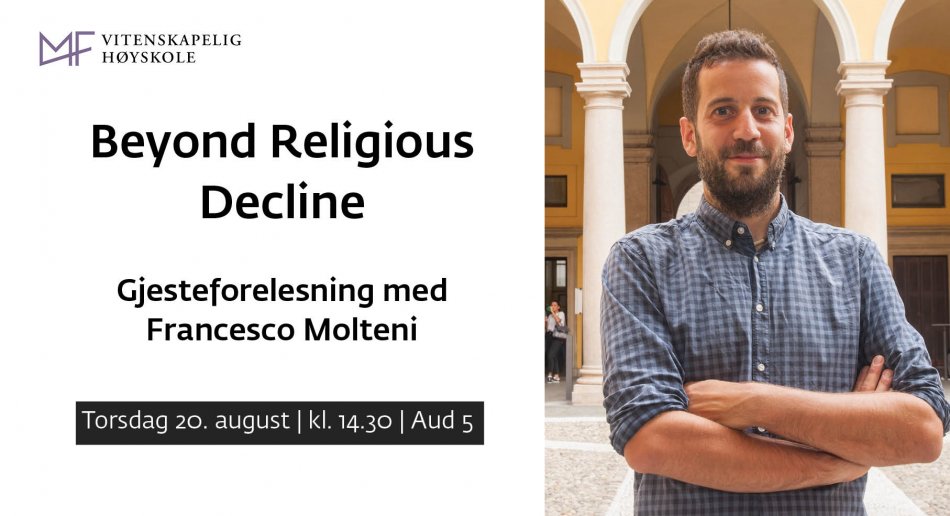
- Time:
- Place: Auditorium 5
- Add to calendar
The Sociology of Religion research group invites you to a guest lecture with Francesco Molteni from the University of Milan. The topic of the lecture is Beyond Religious Decline: Three Dimensions of Individual-Level Secularization.
The lecture will last approximately 45 minutes, followed by a Q&A and discussion. The lecture will be held in English and is open to everyone. Light refreshments will be served.
Abstract for the lecture
Across decades and theoretical traditions, multiple definitions of secularization have been proposed. From Weber’s account of rationalization and the displacement of religious and magical explanations, to Wilson’s emphasis on declining social significance, to Berger’s notion of societal differentiation from religion, and finally to multilevel approaches such as those of Dobbelaere and, in part, Casanova.
When it comes to empirical testing, a substantial body of research has focused on the decline of individual religiosity and its potential determinants. While one group of scholars argues for a generalized, cohort-driven decline in religiosity across multiple dimensions, others emphasize the transformation and individualization of religion, whereby some dimensions gain prominence while others lose relevance.
In this presentation, I argue that many of the nuances proposed by the classical theorists – such as the loss of social significance – can also be adapted to the individual level. I then propose at least three ways in which secularization can be conceptualized and, most importantly, empirically tested using individual-level data.
- Secularization as the decline in the number of people who practice, believe, and identify with a religion, representing the most standard account.
- Secularization as the declining explanatory power of religious affiliation for attitudes, values, and beliefs, focusing on whether and how religious individuals are changing over time and across generations.
- Secularization as the diminishing influence of religious practice, belief, and affiliation on attitudes, values, and beliefs, irrespective of the size of the religious population.
These three approaches will be conceptualized and synthesized, and empirical evidence will be presented using EVS/WVS data from a sample of European countries, focusing on three broad domains of attitudes and values: moral values (e.g., abortion, euthanasia, and divorce), attitudes toward immigrants, and gender attitudes.
Building on these analyses, I will also offer preliminary insights into the potential relationships among these three ways of intending of secularization. For example, a shrinking religious population may either weaken or strengthen the role of religion in explaining attitudes and values, maybe also depending on some contextual characteristics (cross-level interactions). I will finally outline the next empirical steps required to develop a more comprehensive understanding of individual-level secularization in its broader sense.
About Francesco Molteni
Francesco Molteni is a Tenure-Track Assistant Professor (RTT) in the Department of Social and Political Sciences at the University of Milano, where he is also a member of the board of the Network for the Advancement of Social and Political Studies (NASP) PhD program.
He holds a PhD in Sociology and Methodology of Social Research. His main research interests include religion and religious change, values and attitudes' transmission and socialization, migration, and acculturation processes. He mainly works with large-scale comparative and national surveys and has also worked on four original datasets: BOnD, CARPE, ResPOnsE COVID-19 and COValues.
His work has been published in international peer-reviewed journals such as Social Forces, Journal of Ethnic and Migration Studies, Sociology of Religion, European Societies, and the British Journal of Sociology. He has also published with Brill the book "A Need for Religion: Insecurity and Religiosity in the Contemporary World."
He is the P.I. of the project “Between Origin and Destination (BOnD)”, funded by the CARIPLO foundation. In 2025, his article “Rising security and religious decline: Refining and extending insecurity theory” won the Best Article Award from the International Society for the Sociology of Religion (ISSR).