
Contact
Mona G. Bø
Jan-Olav Henriksen
The PhD program at MF includes projects in theology, religion and social studies.
A PhD qualifies you for teaching at the college/university level, for research activities, and for other work where there are high standards of scholarly insight, skill, and well developed analytical thinking. MF's programme is open to applicants from other universities and colleges in Norway and abroad.

Doctoral Degree Programme
- Duration: 3 years
- 180 credits
- Start semester: Autumn and spring
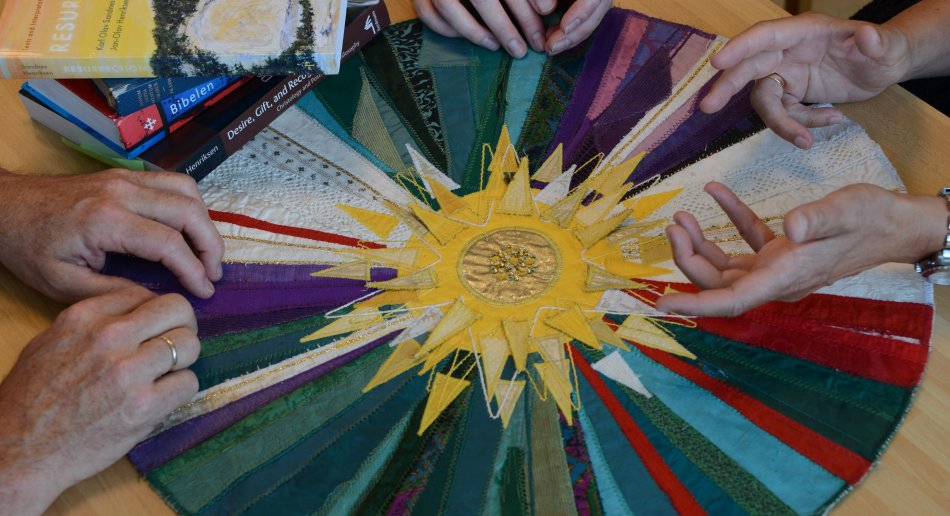
PhD Student at MF
PhD agreement
All doctoral students must sign the Agreement on Admission to the PhD Programme. The agreement consists of three parts (A, B and C) and seeks to describe and regulate the most crucial aspects of the PhD programme at MF. Typically, only part A and B require signatures.
Part C: Agreement between an external institution and MF. This part of the PhD agreement is currently under revision.
Supervision
A practical overview of supervision at MF
The Supervision Relationship
A strong, well-functioning relationship between candidate and supervisor is vital to the success of any PhD project. Your supervisor serves as your academic guide, support person, and project leader throughout the PhD period.
Before applying for admission, you should normally have identified the main supervisor. MF’s website provides information about academic staff, their research areas, and who may be relevant for your project. If you are part of a larger research project, your supervisor is typically already connected to that project.
At least one supervisor—usually the main supervisor—must be employed at MF.
All supervisors must hold a doctoral degree or equivalent expertise and be active researchers. At least one must have previous experience supervising a PhD candidate to completion. In special cases (e.g., collaborative PhDs), MF may also appoint support supervisors with specialized skills essential to your project, even if they do not meet all the qualification requirements.
Multiple Supervisors
PhD candidates at MF may have two supervisors. The supervisory team should be established early, with a clear division of responsibilities. The main supervisor is responsible for coordinating supervision.
If you plan to have a co-supervisor from a foreign institution, a cotutelle agreement may be relevant. This is a formal agreement between two institutions covering joint supervision, research stays, thesis assessment, and more. Contact the PhD coordinator early if this may apply.
Changes to the supervision arrangement can be made during the PhD period. Adjustments should be discussed with current supervisors, and requests are submitted via the PhD coordinator.
Content and Expectations in Supervision
Supervision often begins with refining the project description. If admitted to a preliminary description, you must submit a full project description within three months.
A start-up meeting is recommended to clarify expectations. An expectations form can help establish good communication from the beginning.
The supervision relationship is governed by §7 of the PhD regulations and Part B of the PhD Admission Agreement, which must be signed within two months of program admission. Both the candidate and the supervisor must keep each other informed of issues affecting project progress.
Supervisors are responsible for:
- Advising on the topic, research questions, and project scope
- Discussing methods, results, and academic argumentation
- Guiding research design, documentation, and presentation
- Assisting with literature, data, and archival resources
- Providing guidance on research ethics
- Connecting the candidate with relevant research environments
- Discussing career plans and various steps toward reaching career goals
Candidates are responsible for:
- Keeping supervisors informed about matters affecting progress
- Actively seeking academic guidance
- Following up on agreements
- Submitting thesis drafts for feedback
- Adhering to research ethics in the field
Supervision totals 180 hours over three years, equivalent to approximately 60 hours per year.
When Challenges Arise
Challenges are common in supervisory relationships. The most important step is to address concerns early—first with your supervisor if possible.
If this is difficult or does not improve the situation, you may contact the Pro-Rector or the PhD coordinator. Choose the person you feel most comfortable with for the issue. Early communication increases the chances of resolving challenges effectively.
If obligations under the PhD agreement are not fulfilled, both the candidate and the supervisor must attempt to resolve the issue. If not resolved, either party may request to end the supervisory relationship by contacting phd@mf.no The Pro-Rector makes the final decision, and a supervisor cannot step down until a new supervisor is appointed.
MF also has ethical guidelines for employees, including specific guidelines for teaching and supervision, which candidates should familiarize themselves with.
Supervision After Funding Has Ended
When your funding period ends, continued supervision is not guaranteed. This must be agreed upon between you and your supervisor. Inform the faculty of your arrangement in the annual progress report.
Main Responsibilities of the Supervisor
- Academic leadership: Support with research questions, methods, hypotheses, results, and interpretations
- Planning & follow-up: Create and monitor progress and milestone plans; help ensure deadlines are met
- Research environment & networking: Introduce you to relevant local, national, and international research communities
- Ethics & administration: Ensure ethical standards, necessary approvals, and administrative oversight
- Learning environment: Contribute to a supportive and constructive learning atmosphere
Key Elements of a Good Supervisory Relationship
- Regular, structured supervision: e.g., 72 “face‑to‑face” hours over the project
- Clear communication and expectation management
- Support for developing independence as a researcher
- Considering co-supervisors when projects are interdisciplinary
- Continuous development of supervisory skills
Common Challenges for Supervisors
- Supporting candidates experiencing writing blocks, performance anxiety, or procrastination
- Navigating cultural differences and varying expectations
- Staying updated in evolving fields, including developments in artificial intelligence
Course work
The PhD programme consists of several courses (30 ECTS in total). You are expected to attend the courses while also writing your thesis. Some courses are offered every semester, others every year or more rarely.
Please confer your educational plan on Studentweb to see what courses you need to attend.
50- and 90-percent seminars, revised project description
- Mid-term evaluation is for all PhD candidates admitted to MF. The evaluation is normally led by the prorector. Mid-term evaluation is also referred to as a "50 percent seminar".
- The purpose of the 90-percent seminar is to assess the project in a final phase and evaluate an almost finished manuscript. The seminar gives the candidate the opportunity to present and discuss the project’s results and findings. The 90-percent seminar should normally take place for all PhD candidates admitted to MF’s PhD programme.
See the guidelines for more information about 50- and 90-percent seminars.
Research seminars
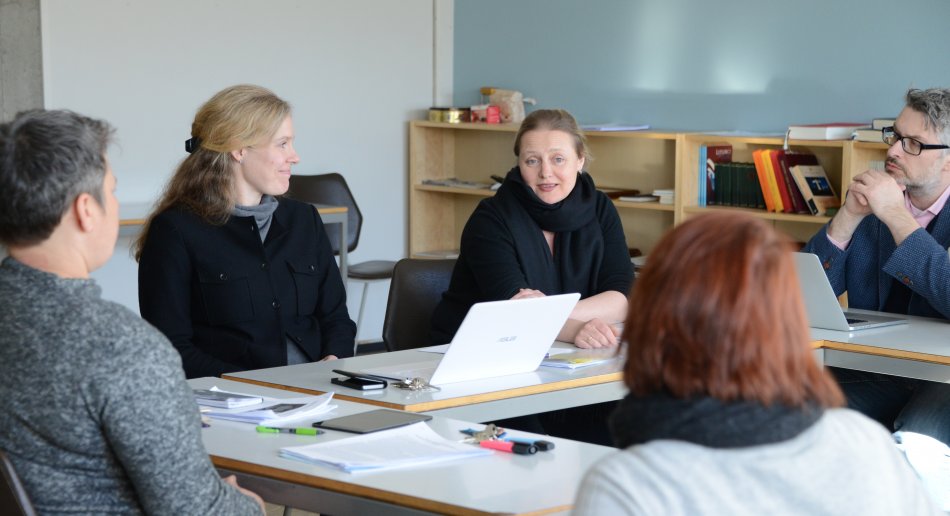
Research seminars, where faculty and doctoral students meet to discuss ongoing doctoral projects, are offered each semester. This is an opportunity to share research ideas and progress, to get constructive help and to give feedback to others.
Papers
You submit a paper (about 15 pages) on Canvas at least two weeks before the seminar. The paper is typically (part of) a thesis chapter or an article. The papers will not be read in the seminar; all participants are expected to have read them beforehand. Please add a “cover letter” explaining the context of your paper. If your work is part of a monograph, please add a tentative table of contents.
The seminar
Every doctoral student is given 45 mins-1 hour to present, get feedback and to join an open floor debate.
The session starts with a short presentation of the paper by the author (max five minutes). This is a chance to point out challenges, questions or paragraphs that call for special attention.
A fellow doctoral student is assigned the task to give a feedback and raise some questions related to the paper (max ten minutes).
A member of faculty, usually not your supervisor of the doctora, gives their feedback (max 20 minutes).
You are given time to respond, either during the feedback or after, according to what is convenient.
This leaves sufficient time for open floor discussion where the other participants, doctoral students and supervisors, contribute.
The aim of this procedure is not to be formal, but to make sure that every paper is given a qualified feedback which draws on the competence gathered.
Research Ethics
Research projects and academic work at MF are to be in accordance with current legislation and recognized norms for research ethics.
Article-based PhD-theses
The thesis, the introduction excluded, will normally extend to three normal-size articles in academic journals. It is required for assessment of a PhD-thesis that the candidate is the main
author and has an extended academic responsibility for a majority of the articles that are included in the PhD thesis.
Monograph
If you choose to write your dissertation as a monograph, there are no specific rules for how to do it. In general, this option provides a more flexible design for your dissertation.
The requirements in terms of what it should contain, are the usual:
- definition of and motivation for research questions
- delineation of material
- theory and method
- outline of structure and identification of the main aims for the work.
As a general rule, the size of the work should be around +/ - 100 000 words, 200-250 pages, but this depends on the topic and the material you research.
One good advice is to look at the work of someone who has done this before you, and has had a favourable reception of their dissertation and a successful defence.
Submitting your PhD at MF
The formal requirements regarding submission of the PhD dissertation are described in Regulations for the degree of PhD at MF (Forskrift for graden ph.d. ved MF).
Article-based dissertations must follow the Rules for article-based PhD-dissertations, and Declaration of independent Research.
Between PhD Submission and Defence
You will receive a copy of the letter of appointment to your examination committee. MF appoints the examination committee based on advice from faculty and according to the regulations. The supervisor(s) and the candidate are not involved in this.
Within a month after submission we will set a tentative date for your public defence. This is not an indication of a positive examination result.
The examination committee will give their examination report within 3 months from appointment. You will receive the report immediately.
For more details about the time between submission and defense, see the general timetable for PhD Trials at MF.
Errata List
If you wish to correct typographical/language errors in the submitted thesis before it is printed, you have the opportunity to submit an errata list.
What is an errata list?
An errata list is a list of specific corrections of formal errors (layout, correction of printing errors and/or pure language errors) that you wish to make in the thesis before it is printed. In practice, correcting formal errors means making the text meaningful or linguistically correct, not clarifying/changing the meaning of the text.
Even if you are notified before the defence that a submitted article has been approved or published by a publisher, but in a revised form, you are not allowed to replace the accepted article with the one included in your thesis. It is the submitted article manuscript that will be used as the basis for the defence. In the preface to the thesis that is printed for the defence, you can refer to the final journal article.
Who should have the errata list, and when must it be submitted?
As soon as you discover errors in your thesis, you should prepare an errata list and submit it according to the timetable. If you have listed changes that MF or the assessment committee consider to be substantive, the changes will not be approved. The errata list should be sent to phd@mf.no
Trial Lecture and Public Defence
The trial lecture is a test of how you give an academic lecture. It is not a purely pedagogical test. It is to be related to / based on research, with a presentation of the issue, an independent discussion of the material (not just of the current research discussion) and a conclusion of one's own. The topic for the trial lecture will be given ten days before the day of the public defence.
The public defence is an open event where you present and defend your doctoral thesis in public to two critical opponents from the expert committee. The public defence is chaired by the Rector or pro-rector. You have to pass the trial lecture and public defence to be awarded the PhD degree.
Feel free to invite friends and family to the public defence.
For more detailed information about the trial lecture and public defence, please see the timetable for PhD trials, which can be found under "Between PhD Submission and Defence".
Fields of Research
MF’s research is centred around the fields of Theology, Religion and Society, including disciplines such as:
- The Old Testament/Hebrew Bible (OT/HB)
- The New Testament (NT)
- Church History and Cultural History
- Systematic Theology
- Ecumenism
- Ethics
- Practical Theology
- Diakonia
- Religious Education
- Religious Studies
- Sociology of Religion
- Psychology of Religion
- Social Sciences
- Missiology
Useful links
Research news
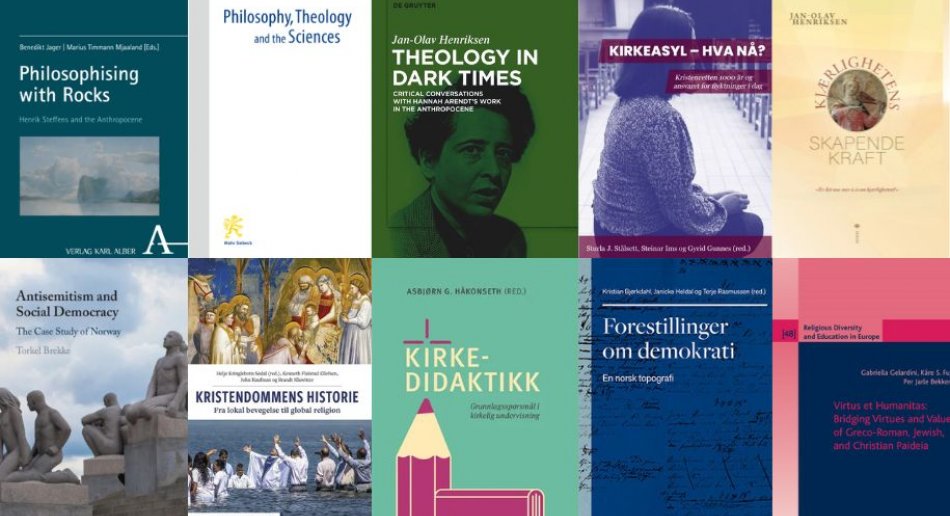
Publications from MF reserachers
Published: 23. September 2026
Through books, book chapters, and scholarly articles, researchers at MF contribute to new knowledge and academic dialogue, both nationally and internationally. Here is a selection of publications from recent times.
Writing and teaching Contested History
Published: 17. July 2026
As competing memories meet official narratives in the classroom, the question becomes not only what history is taught, but whose stories are told.
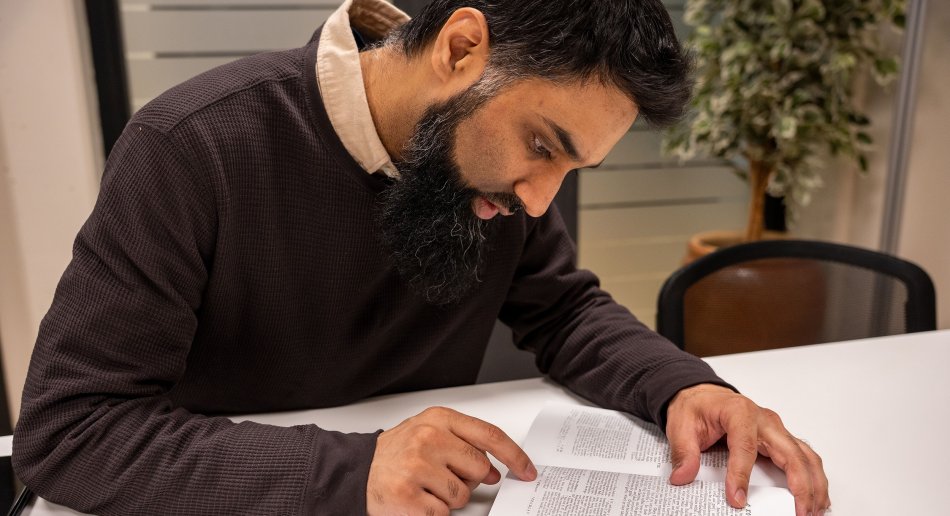
An Overlooked Part of Europe’s Intellectual History
Published: 24. April 2026
A central part of Europe’s intellectual history has long been overlooked, says Doctoral Research Fellow Zeshan Ullah Qureshi.
– Europe has not only imagined Islam. It has read, translated, and interpreted the Qurʾān for nearly a thousand years.

What Makes Engagement Truly Meaningful?
Published: 30. March 2026
Volunteering is often celebrated as a force that strengthens communities, nurtures solidarity, and fills societal gaps. But what actually happens to individuals when they begin volunteering?