

New Regulations on Admission, Studies and Examinations at MF
From 1 August 2026, a revised regulation enters into force. Below you will find an overview of the most important changes and what you need to know.
Do you have any questions?

How to familiarize yourself with the new regulation
As a student, it is your duty to know the rules that apply to your program. Here are the easiest ways to get started.
- Attend the information meeting at the start of the semester: MF will hold information meetings about the new regulation in connection with the start of the autumn 2026 semester. Remember to check your schedule.
- Use the glossary: We have prepared a glossary explaining key terms in the regulation – including words that may be used somewhat differently at different institutions. See the glossary here.
- Contact the Student Advisors with questions: If you have questions about what the new regulation means for your situation, contact the Student Advisors.
Key differences between the old and new regulation
The new regulation has been substantially restructured and now has a clearer division into chapters. The most important substantive changes are summarized below.
| Topic | Old regulation (2005) | New regulation (2026) | Rationale |
| Structure | One long regulation with §§ 1–55, a mix of rules and definitions. | 12 thematically organized chapters, easier to navigate. | New – The chapter structure has been adjusted to make the regulation easier to read. The revision became so extensive that it was found appropriate to create an entirely new regulation rather than revise the old one. Definitions of key terms have been removed, and we have made a glossary of terms that might be unfamiliar to students here. |
| Study-right period | Up to two years beyond standard duration for all programs; unclear whether this applied to one-year programs. | Degree programs: up to two extra years. One-year/part-time programs: up to one extra year. A further year may be applied for on special grounds. | Changed – The ambiguity in the current regulation regarding one-year programs has been resolved. The intention is to make the provisions easier to understand and to ease the administrative work of the study administration. |
| Study progression | Less than 50% progression over a two-year period (earliest two years after admission) could result in loss of study right. | Requirement of at least 50% of standard progression each academic year from the first year; exemption may be applied for. | Changed – Previously, a student had to have low progression over two years before anything was flagged. The new requirement applies from the first year of study to help students establish good study habits and to enable closer follow-up. It is sufficient to assess progression once a year (compared to every semester previously). An exemption may be granted on special grounds, e.g. for students who need extra time to adjust to higher education. |
| Leave of absence without documented grounds | Not explicitly provided for – required special grounds. | Students may apply for up to one year (two semesters) of leave without documented grounds, provided certain progression requirements are met. | New – The stricter rules are balanced by a more liberal leave-of-absence scheme. The scheme will ease case processing in the Study Administration, which will no longer need to make discretionary assessments of these applications. Several other institutions have similar rules. |
| Examination offences – artificial intelligence | AI not specifically mentioned. | Presenting AI-generated content as one's own without sufficient source referencing is explicitly defined as potential cheating. | New – Added by MF in addition to the Norwegian Association of Higher Education Institutions' (UHR) national guiding principles on cheating, which have otherwise been incorporated in full. The new Universities and University Colleges Act continues to let each institution regulate what constitutes cheating itself. UHR has encouraged coordination between institutions to ensure equal treatment. |
| Examination offences – reuse of one's own work | Not specifically regulated. | Improper reuse of one's own previously submitted work may constitute cheating, but the sanction is annulment only – not expulsion. | New – In line with guidance from the Ministry of Education and Research and UHR's guidelines: reuse of one's own work that has not previously earned credit cannot be regarded as cheating. Where reuse is nevertheless improper, annulment is a sufficient sanction. |
| Master's thesis – resubmission | Six months' waiting period for all master's theses. | Theses ≤ 30 credits: three months' waiting period. Theses > 30 credits: six months. Exemption possible following supervisor's assessment. | Changed – The waiting period is meant to give the student sufficient time to address the deficiencies that led to the thesis not being passed. Longer theses are given a longer deadline, as the scope of necessary rework will normally be greater. |
| Mandatory activities | Referred to as "study requirements"; limited regulation of transfer and number of attempts. | Referred to as "mandatory activities"; approved activities can be carried forward up to two years; the number of attempts and consequences of non-approval are specified. | Changed – "Mandatory activities" is standard terminology in the sector and communicates more clearly to students that this is a condition for sitting the exam. A decision on loss of the right to sit an exam due to non-approval is an individual administrative decision under the Public Administration Act – this is now specified in line with the statutory requirement. |
| Adaptation/special arrangements | Application per exam period; exception for chronic conditions | Application each semester; a decision on permanent exemption is possible. Deadline: the semester registration deadline | Changed – Read more on MF's website: Adaptations in daily student life and Adaptations for exams. |
| Diploma | Issued in Norwegian or English; one diploma per degree. | Normally a digital diploma. Paper diploma issued only once; a duplicate may be issued, possibly for a fee. | Changed – A continuation of the current rules, with the addition that students can now be issued a duplicate of a paper diploma if the original is lost. |
| Digital examinations | Not explicitly regulated | A dedicated chapter: the student is responsible for their own digital equipment (laptop) and for submitting the correct version of their answer | New – Digital examinations are already standard practice at MF but have not previously been regulated. The requirement that students must have their own laptop is based on the Act on tuition fees at universities and university colleges. |
What you should know if you are not following standard study progression
The new regulation is clearer than the old one about the rules that apply to students who are delayed, on leave of absence, or have been granted reduced progression.
Requirements for study progression (§ 5-3)
To retain your study right, you must complete at least half of the standard progression for your program each academic year. If you do not manage this, you can apply for an exemption if there are special grounds.
Study-right period (§ 5-4)
For degree programs, the study right can be extended by up to two years beyond the standard duration. For one-year and part-time programs of at least one year's duration, the limit is one year. A further year may be granted on special grounds. Approved leaves of absence and temporary exclusion do not count toward this time limit. Programs of less than one year normally do not give the right to an extended study period.
Leave of absence (§ 5-5)
The new regulation gives you the right to up to one year of leave without documented grounds, provided you have completed at least 30 credits in the last academic year and at least 60 credits since your last leave of absence. Note that this right does not apply to students receiving supervision on a bachelor's or master's thesis.
Application deadlines: 1 September (autumn) and 1 February (spring).
Conditional admission – missing credits (§ 2-20)
Applicants to master's programs and further-education programs who are missing up to 20 credits may be granted conditional admission if the delay is due to circumstances beyond the applicant's control. Outstanding exams must be passed by the set deadline.
Loss of study right (§ 5-8)
Study right may be lost due to, among other things, failure to register for the semester, non-payment of tuition fees, exhausted practicum attempts, or failure to meet the conditions of a conditional admission. You will always be notified and given the opportunity to comment before a decision is made.
Important information about examinations
Below is an overview of the most important examination rules in the new regulation.
Number of exam attempts (§ 6-3)
You may sit the exam in the same course up to three times. A fourth attempt may be granted upon application in special cases, but not if you have already passed the course. Courses with substantially the same academic content are considered "the same course." The number of attempts follows you as a student, not your study right.
Master's thesis (§ 6-3, third paragraph)
If you receive a fail grade (F) on your master's thesis, you may submit a new or reworked thesis once. Waiting period:
- Theses of ≤ 30 credits: minimum three months after the grade is issued
- Theses of > 30 credits: minimum six months after the grade is issued
An exemption may be granted based on the supervisor's recommendation.
Withdrawal deadline (§ 9-9)
If you wish to withdraw from an exam you are registered for, you must observe the published withdrawal deadline. If you miss the deadline, it counts as an exam attempt – even if you do not show up.
Valid absence (§ 9-2)
Acute illness that prevents you from starting or completing an exam is considered a valid absence and does not count as an attempt. MF may require documentation and set a deadline for submitting it.
Digital exams and your own equipment (§ 9-5)
MF normally holds exams on a digital examination platform. You are responsible for:
- Familiarizing yourself with how the platform works
- Bringing an approved laptop that meets the system requirements
- Setting up your equipment before the exam begins
- Submitting the correct version of your answer, including all attachments
Artificial intelligence (AI) and cheating (§ 10-7)
The new regulation explicitly states that presenting AI-generated content as your own, without sufficient source referencing or marking of quotations, may be considered cheating. The same applies to unauthorized collaboration, fabrication of data, and reuse of your own previously submitted work without disclosing this. For improper reuse of one's own work, the sanction is annulment; other cheating cases may result in stricter consequences under the Universities and University Colleges Act.
What counts as permitted use of AI will vary from course to course and will always be stated in the course description. MF has its own guidelines on the use of AI in academic work – read more on Use of AI in submissions.
Appeals and justification of grades (§ 10-6)
The right to a justification for a grade and to appeal grades and formal errors is regulated by sections 11-8 to 11-10 of the Universities and University Colleges Act. Read more at Justification and appeals.
More articles from News

Condolences Following His Majesty King Harald's passing
Published: 28. August 2026
Det er med stor sorg vi har mottatt budskapet om at Hans Majestet Kong Harald V har gått bort.
MF kondolerer kongefamilien og lyser fred over Kong Haralds minne.
MF becomes part of MishMash
Published: 15. June 2026
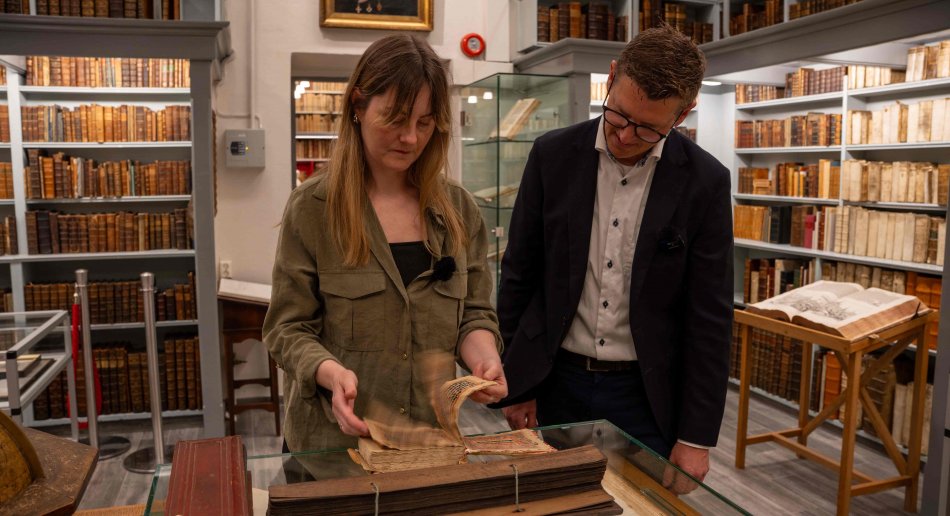
MF has entered into an agreement with MishMash – Centre for AI and Creativity to conduct research on manuscripts and cultural heritage.

MF Affected by Data Breach in Canvas
Published: 7. May 2026
Instructure, leverandøren av læringsplattformen Canvas, har avdekket at en kriminell aktør har kopiert personopplysninger fra et system hos dem, hentet ut informasjon og krever løsepenger. Instructure har nå bekreftet at også MF vitenskapelig høyskoles data er omfattet av angrepet.
Artificial Intelligence and the Humanities: New Opportunities and Challenges
Published: 18. February 2026
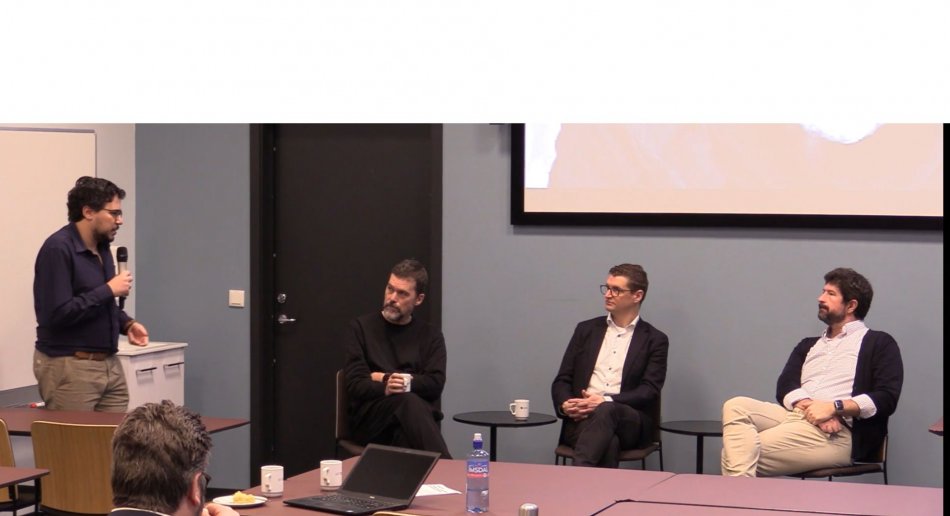
In December 2025, L-MaSDR hosted a seminar exploring the opportunities, challenges, and responsibilities that AI presents for humanistic research. Watch the presentations here.