
Using AI Agents to Prototype a Manuscript VRE
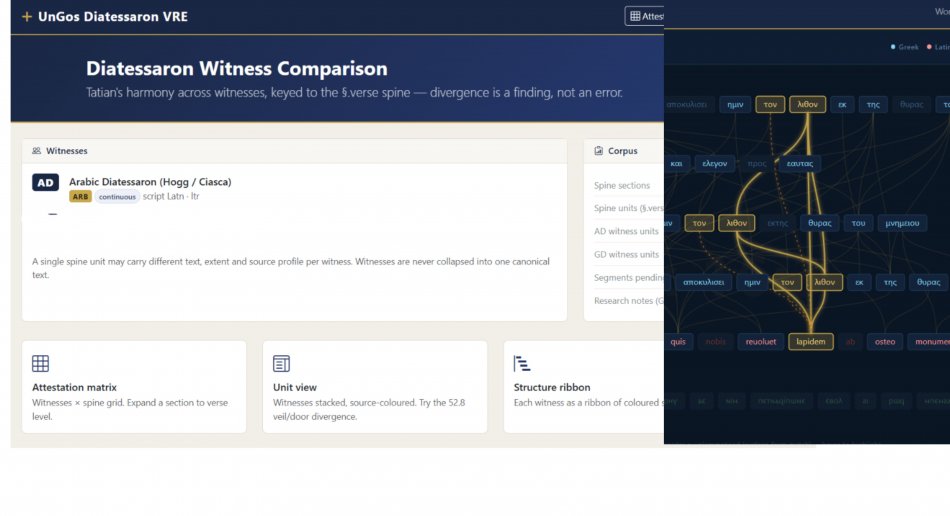
This post presents an experiment in AI-assisted digital humanities development. Using Claude Code, I built a local prototype of a Virtual Research Environment (VRE) for the study of Tatian’s Diatessaron. The purpose was to test whether AI-assisted coding can help transform manuscript data, research notes, and a conceptual model into a working tool for visualization, collation, and textual comparison.
The Diatessaron
The Diatessaron is an ancient gospel harmony: a single continuous narrative woven from Matthew, Mark, Luke, and John. This makes it a fascinating, but technically difficult, object for digital analysis. A Diatessaron verse is not simply “a verse from Matthew” or “a verse from Luke.” It may combine phrases from several gospels, and different witnesses may preserve different versions of the same harmonized unit.
The prototype VRE was built to make this complexity visible.
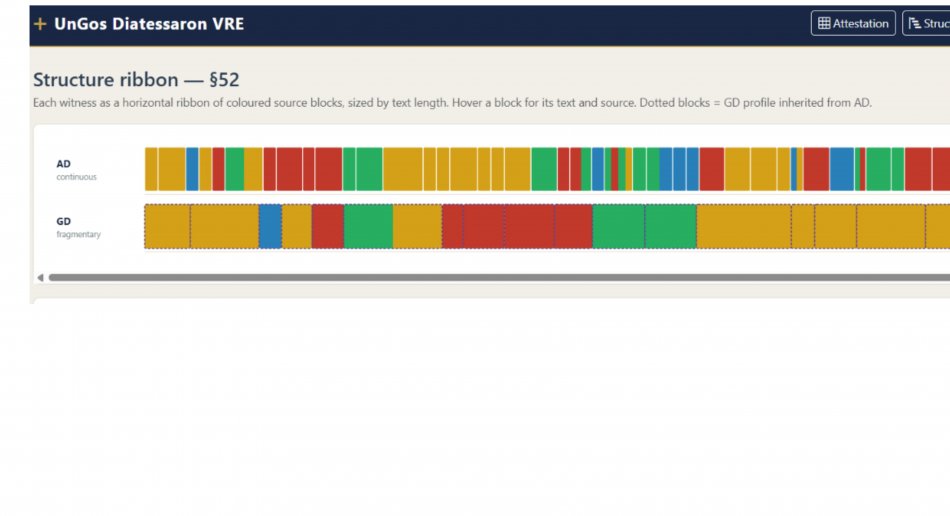
Colour-Coding the Gospel Sources
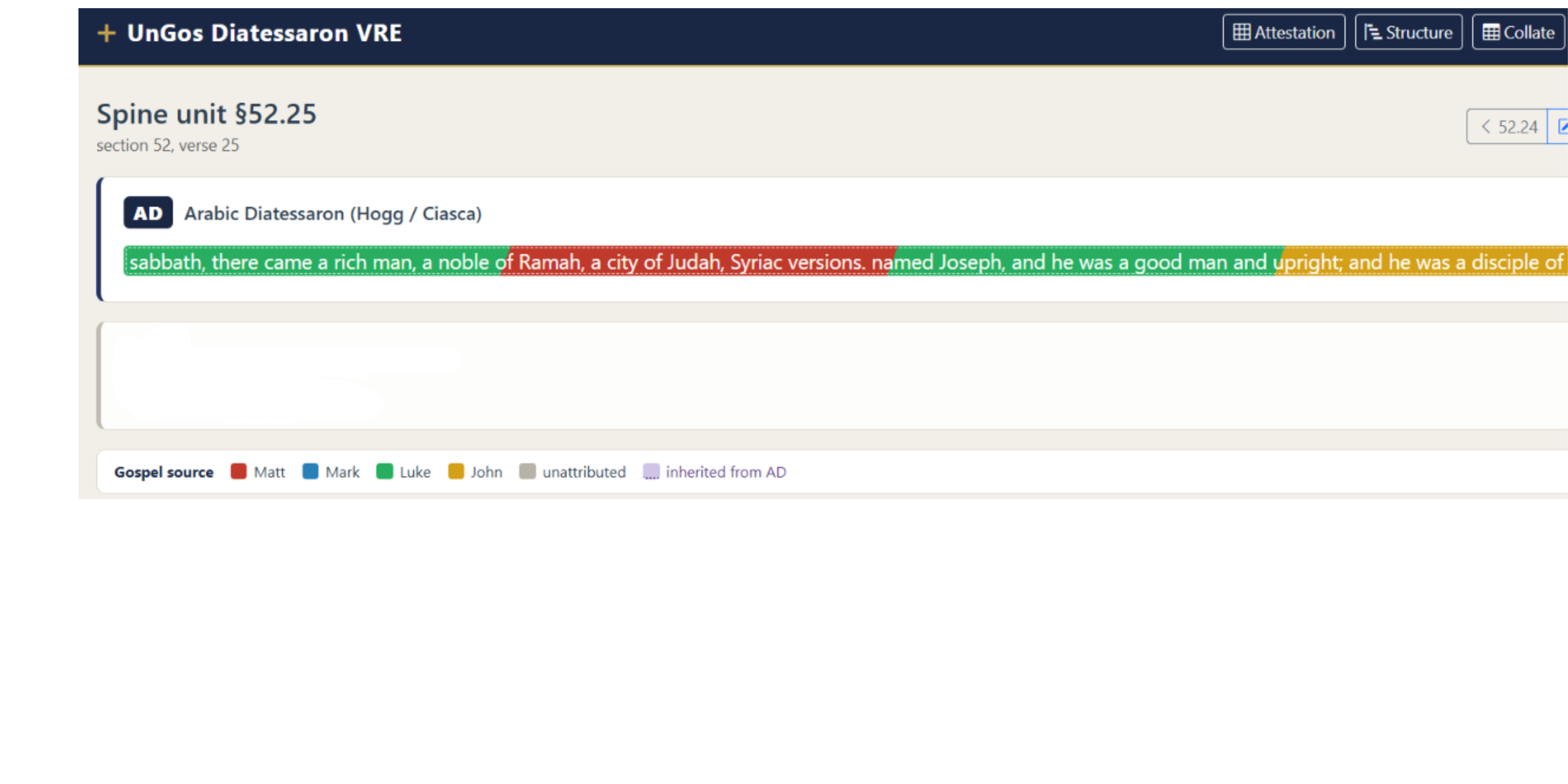
One of the most useful features is the colour-coded source view. Each phrase can be tagged according to the gospel source it reflects. Matthew, Mark, Luke, and John are then visualized as coloured segments inside the Diatessaron text. This makes the compositional structure of the harmony easier to inspect at a glance.
The colour coding is based on available metadata and provisional annotation, and may contain errors or oversimplifications. All source assignments require scholarly verification before they can be cited as findings.
MARK16 alignment tool
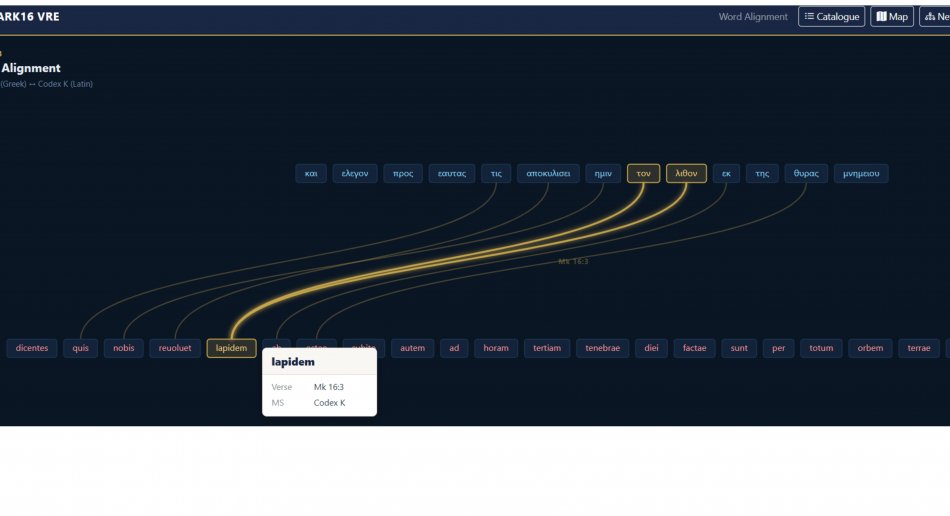
An earlier prototype shows how manuscript comparison can be explored through interactive digital interfaces. In this example, the Latin word lapidem is aligned with its Greek counterpart. The tool is also able to identify that the Latin noun corresponds to a Greek noun phrase, including both the article and the main noun, even though Latin has no equivalent article here.
Methods and Procedure
The VRE was developed locally using Claude Code. I created a project directory on my computer to which Claude Code had access, and placed the relevant source material there, including manuscript transcriptions in TEI-XML format. I then described the desired output in detail, the alignment logic, and the use of colour-coded gospel-source visualization. I also pointed Claude Code to comparable VREs that already exist for interface structure and functionality.
Technically, the prototype was implemented as a Flask web application with a SQLite database. Python scripts were used to ingest structured seed data into the database, using the Diatessaron section-and-verse system as the common reference spine. The web interface was built with HTML templates, CSS, and JavaScript, including visual views for attestation, collation, and gospel-source structure. The resulting Diatessaron VRE currently runs locally on my computer and has not yet been deployed publicly on the web.
Experiences and Limitations of AI-Assisted VRE Development
Claude Code made it possible to develop a functional VRE prototype with limited practical coding experience. By providing source material, clear requirements, and comparable examples, I was able to produce a searchable database, a Flask-based interface, visualizations, and experimental alignment tools in a short time. This shows the potential of AI-assisted coding for rapid prototyping in digital humanities.
However, the method also raises important concerns. The user must carefully control what files and folders the AI agent can access, since broad permissions may create risks related to privacy, unintended file changes, deletion, or data exposure. Repeated permission requests can also lead to permission fatigue, where one gradually becomes less critical of what is being approved. The resulting prototype still needs technical evaluation, since a professional developer might identify weaknesses in security, maintainability, scalability, or code quality. There is also a strategic dependency: if tools such as Claude Code or ChatGPT’s coding tools are withdrawn, restricted, or changed, the project may become vulnerable, especially if one has chosen not to hire a professional developer. AI-assisted VRE development is therefore promising, but should be combined with technical oversight and long-term maintenance planning.
You can create websites and lighter tools with the free version of Claude, but in order to use Claude Agents through Claude Code or Cowork, and have larger usage limits, you have to subscribe to Claude Pro (Pay tier). And even with Claude Pro, I sometimes used all my usage tokens after a few hours of coding. It is recomendable to switch to a lighter model that use less tokens when doing lighter work, in order to keep your session going for longer. OpenAI offers Codex, which is a similar tool as Claude Code/Cowork. You can test it for free with a very limited usage quota, but you would need the pay tier version to do substantial agentic AI work.
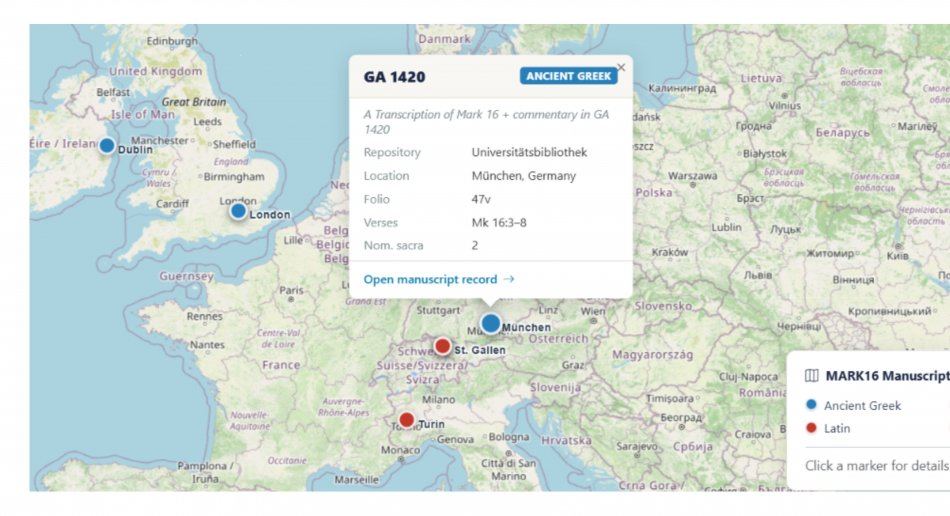
Other features of the VREs:
AI Use Declaration
The VRE prototype were developed with assistance from Claude Code (Claude Pro). ChatGPT and Claude was used to draft and refine parts of the blog post. All scholarly framing, source selection, interpretation, and final editorial responsibility remain with the author.
More articles from MF L-MaSDR, AI, digital humaniora, Digital humanities, KI, manuscripts, VRE, manuskripter, diatessaron, gospel harmonies, gospelharmonier and Virtual research environment
The Director of MF L-MaSDR Identifies a New Manuscript in Zürich
Published: 28. September 2026
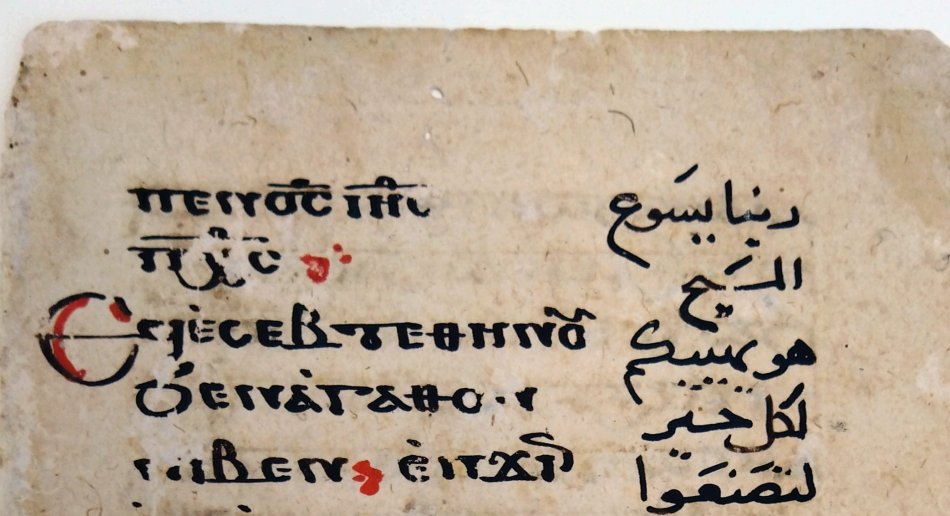
During his visit to the Zentralbibliothek Zürich, Mina Monier had the privilege of examining uncatalogued material, among which he identified a previously unrecognised Coptic–Arabic manuscript fragment.
Distant Reading: analyzing the Gospels with Python and AI
Published: 19. February 2026
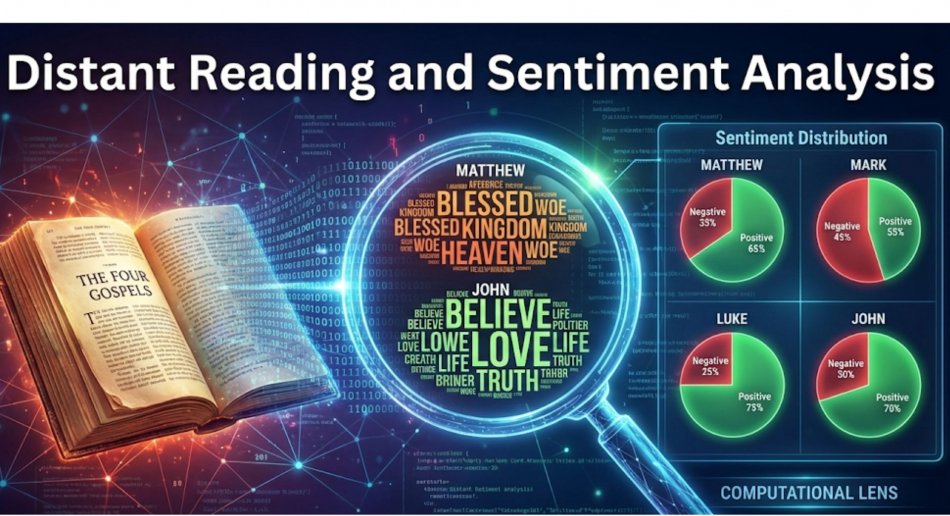
In Digital Humanities, distant reading uses computational tools to explore patterns across texts - patterns that may be difficult to perceive through close reading alone. Instead of replacing traditional interpretation, it complements it by providing statistical overviews that highlight tendencies, repetitions, and contrasts.
Artificial Intelligence and the Humanities: New Opportunities and Challenges
Published: 18. February 2026
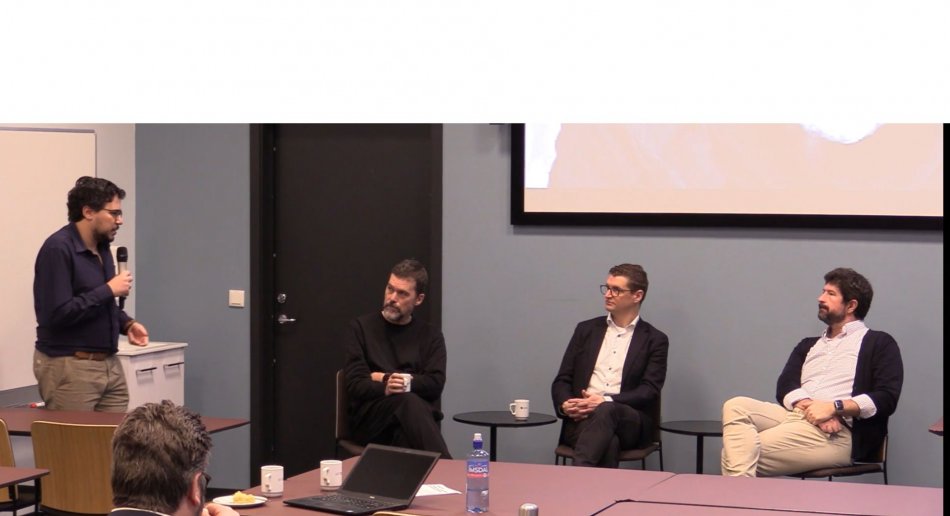
In December 2025, L-MaSDR hosted a seminar exploring the opportunities, challenges, and responsibilities that AI presents for humanistic research. Watch the presentations here.
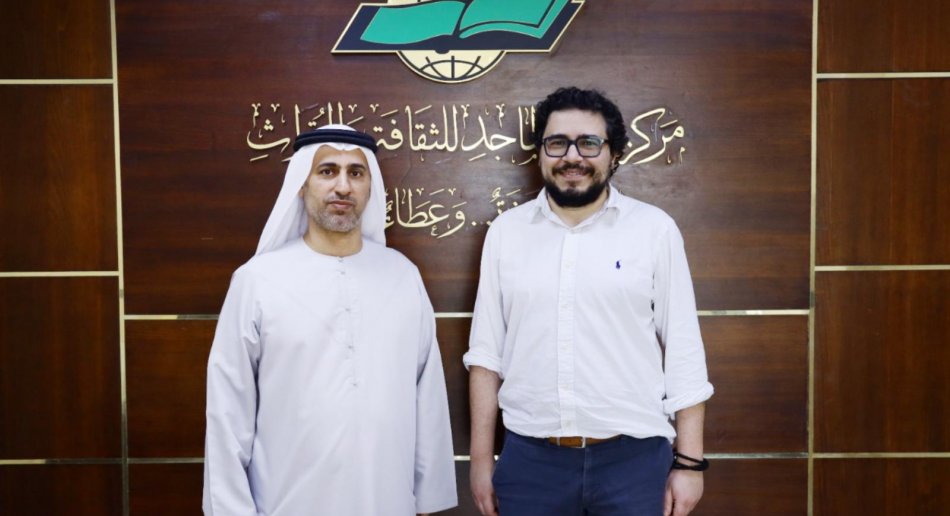
A Visit to Juma Al Majid Center for Culture and Heritage
Published: 29. January 2026
During a two-week research stay in the United Arab Emirates, sponsored by the NYU Abu Dhabi Humanities Research Fellowships, the director of MF L-MaSDR had the opportunity to engage with several pioneering institutions.