

Text Data Mining the Norwegian Press: Religious Minorities in the National Library’s N-grams
When did Islam, Judaism and other minority religions enter the Norwegian newspaper, and when did they peak? I used an AI agent, Claude, and the National Library of Norway's free N-gram dataset of 4.7 million newspaper issues to find out.
Text data mining and n-grams
Text and data mining (TDM) means using digital tools to search, mine, and analyse unstructured textual data (UiO Library). An n-gram is a sequence of one or more elements, generally words, and its pattern over time (UiO Library). The National Library of Norway (NB) has already tokenised and counted the words in its newspapers, so I worked on derived data in this experiment, not doing the TDM from scratch. Make sure to follow legal practice when performing TDM - more about that in the final paragraph.
Method
I downloaded the newspaper unigrams from N-grams from the National Library of Norway 2026, a 14 GB file released under CC0. I then gave Claude, running in Cowork mode in the Claude desktop app, access to that one folder on my laptop and asked it to suggest analyses for religious studies. Of its six suggestions, I chose a review of terms related to religious pluralism.
Claude built a word list of 25 term groups, including inflected forms and older spellings. Examples are muslim, muhammedaner, jøde, synagoge, buddhisme and sikh. They were analysed in its cloud workspace. In about nine minutes Claude returned a Python script, three CSV files and two charts. The script documents every step, so the analysis can be checked and rerun, which is good for scientific reproducibility and credibility.
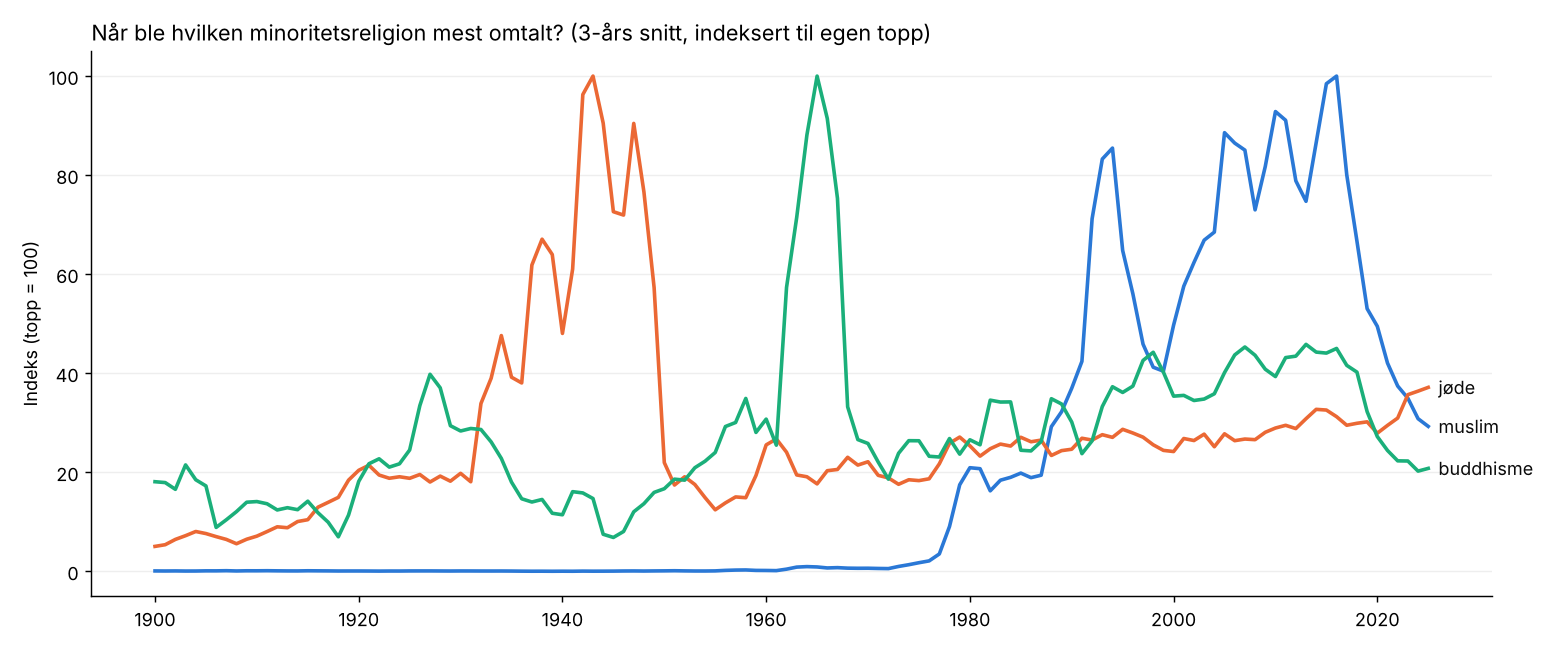
Figure 1. Muslim, jøde and buddhisme, 3-year moving average, indexed to each term's own peak (= 100). Source: NB N-gram 2026, CC0.
The term jøde (Judaism) has its peak around World War 2. Regarding the term buddhisme, you clearly see a peak in the 1960's. The term muslim was hardly used before the 1980's, and it has several spikes in recent decades. This makes me curious about what other similar "Muslim" words were used before the 1980's, so I prompted Claude to produce a chart for that. See figure 2. below.
Many peaks coincide with known events, but n-grams show only that a word is used, not how. This blog post emphasises methods over findings, so it will not discuss and conclude over the results in a substantial way.
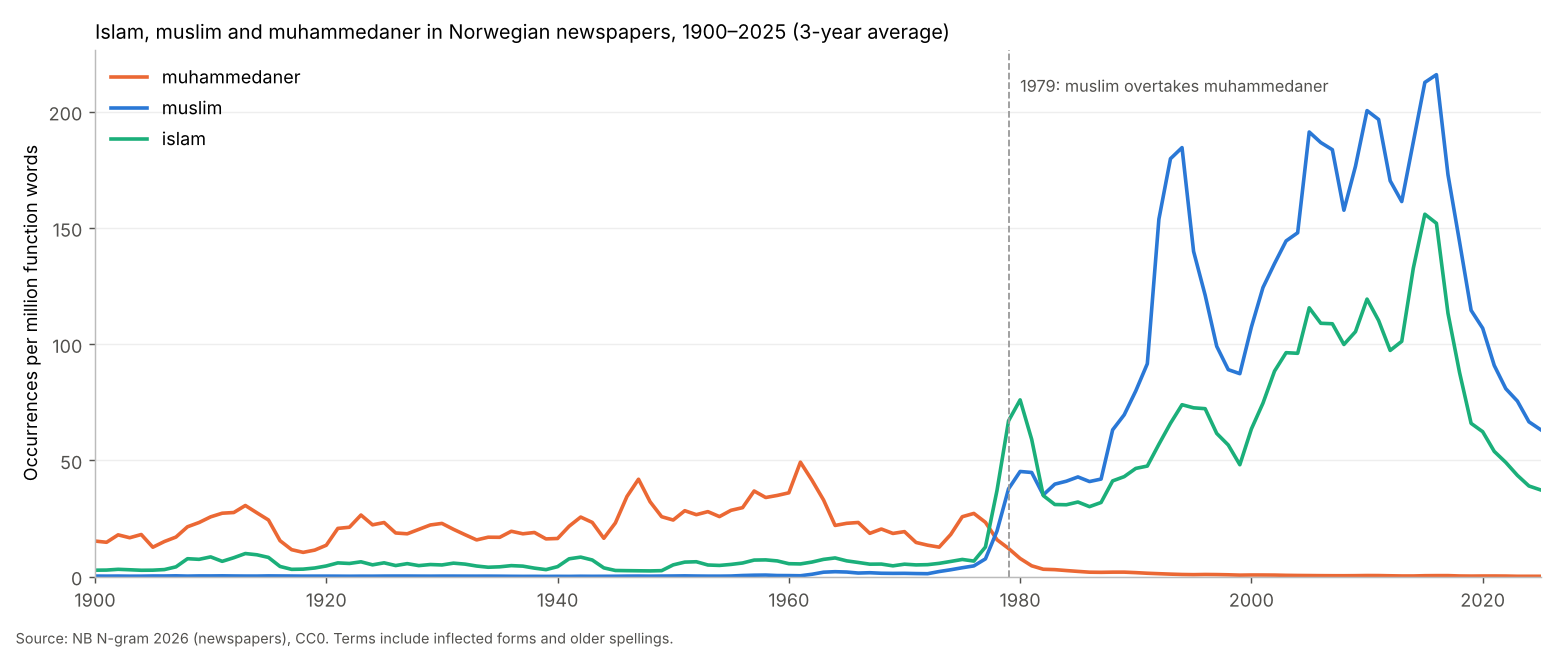
From figure 2. we see that the terms muhammedaner and islam used to be more frequent in use than muslim. That was until muslim surpassed muhammedaner in 1979, and surpassing both by 1982. Below, in figure 3, you see the results for a selection of other terms related to religious pluralism.
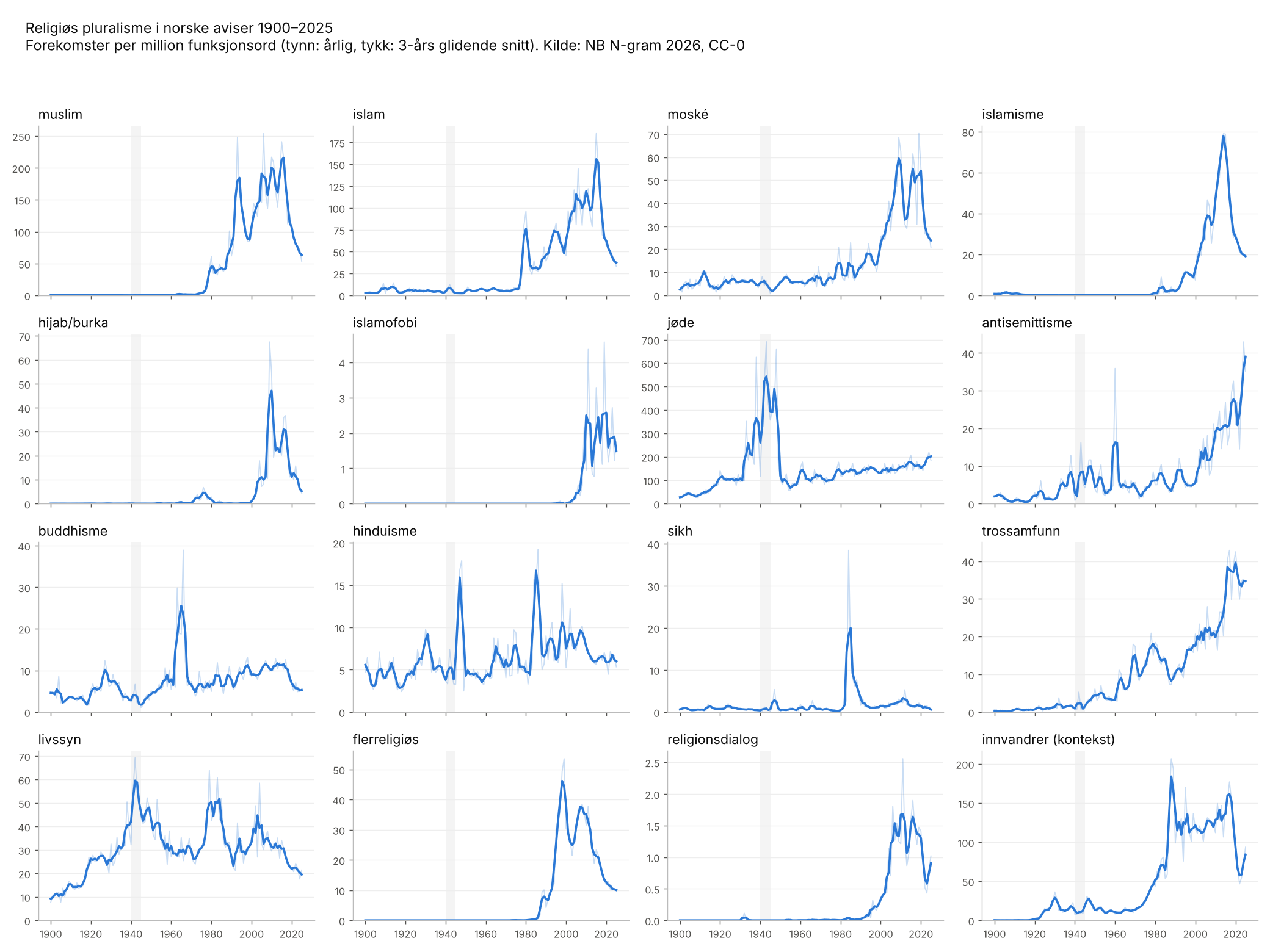
Figure 3. 16 terms related to religious pluralism, occurrences per million function words. Thin line: yearly; thick line: 3-year moving average. Source: NB N-gram 2026, CC0.
Less AI
It is possible to decrease the use of AI, or to leave it out completely if you are proficient in coding. In a hybrid approach, the AI writes the code, and you run it yourself in Python and Jupyter, so the data never leaves your computer. This method also uses less energy. UiO lists suitable tools for text mining. The DH-lab at MF can help you with both the AI approach and the hybrid approach using Python and Jupyter notebook.
Atekst/retriever
Atekst is an important service for searching Norwegian newspapers for PhD candidates and academic staff, but unfortunately it does not readilly allow TDM.
Legal TDM, and possibly a new law facilitating TDM in research
Technical accessibility does not in itself make a source legally minable. For instance, you cannot mine articles from open news papers like NRK or article copies archived in Wayback Machine, without permission. Norway has no clear legal basis for that yet. However, that might change: Prop. 41 LS (2025–2026) proposes changes to the Copyright Act, including a general TDM exception for lawfully accessible works and a specific exception for research and cultural-heritage institutions. The parliamentary committee issued its recommendation on 10 November 2026, but the amendments have not yet entered into law.
In the meantime, NB's n-grams offer an open and legal playground for doing extensive and interesting TDM research.
Next, you can move on from unigrams and explore bigrams and trigrams, to see which words surround muslim - for instance norske muslimer (norwegian muslims) - in different time periods, using the national library's n-gram service.
AI Use Declaration
The analysis was carried out with Claude (Anthropic), running in Cowork mode in the Claude desktop app. Claude suggested the analyses, wrote and ran the code, produced the charts, and drafted this post from my notes, which I then revised. The research question, the interpretation of the results and final editorial responsibility remain with the author. Header image: AI-generated illustration created with OpenAI’s image generation tool in ChatGPT, 11 November 2026.
More articles from MF L-MaSDR, Research, AI, digital humaniora, Digital humanities, Distant reading, KI, TDM, text data mining, tekstutvinning and religious minorities
The Director of MF L-MaSDR Identifies a New Manuscript in Zürich
Published: 28. September 2026
During his visit to the Zentralbibliothek Zürich, Mina Monier had the privilege of examining uncatalogued material, among which he identified a previously unrecognised Coptic–Arabic manuscript fragment.
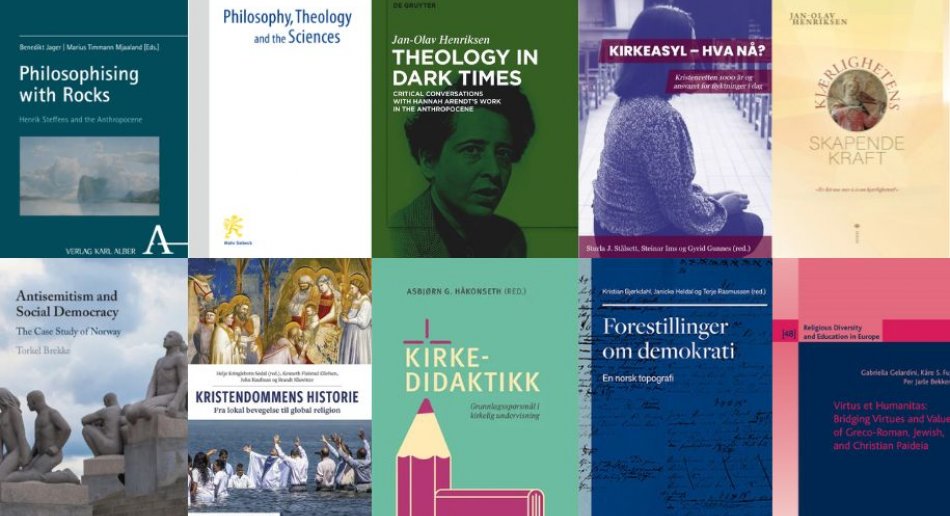
Publications from MF researchers
Published: 23. September 2026
Through books, book chapters, and scholarly articles, researchers at MF contribute to new knowledge and academic dialogue, both nationally and internationally. Here is a selection of publications from recent times.
Writing and teaching Contested History
Published: 17. July 2026
As competing memories meet official narratives in the classroom, the question becomes not only what history is taught, but whose stories are told.
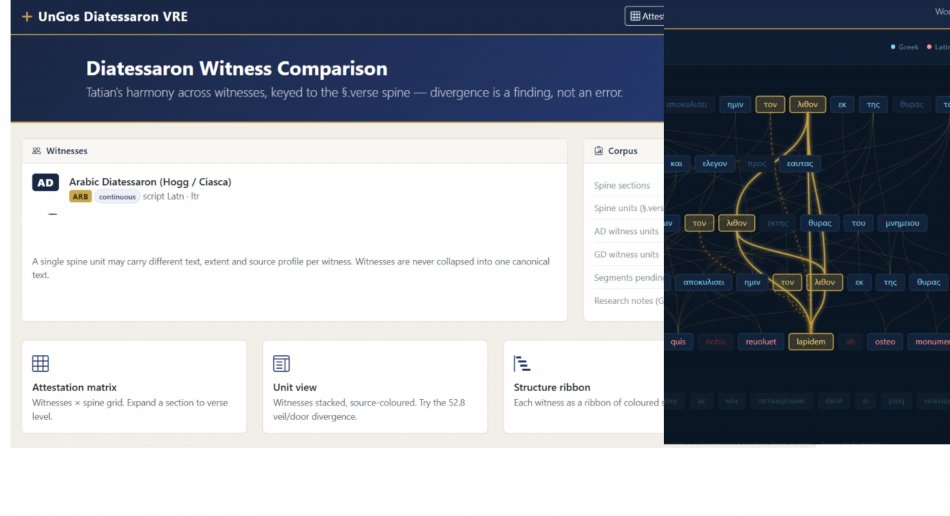
Using AI Agents to Prototype a Manuscript VRE
Published: 25. June 2026
This post presents an experiment in AI-assisted digital humanities development. Using Claude Code, I built a local prototype of a Virtual Research Environment (VRE) for the study of Tatian’s Diatessaron. The purpose was to test whether AI-assisted coding can help transform manuscript data, research notes, and a conceptual model into a working tool for visualization, collation, and textual comparison.