

'From the River to the Sea'. Religion and Politics in the Middle East, Past and Present
After Hamas’ terrorist attack on Israel on 7 October 2023 and the subsequent warfare between Israel and Hamas, the expression “From the River to the Sea” has been frequently used, debated, and condemned by various sides of the conflict, as well as internationally.
The article is written by Kristin Joachimsen and is based on her new artcle "From the River to the Sea".

Looking back in time, we find that variations of this expression have been used both in modern Zionism and by Hamas. The expression and the ideas associated with it also resonate in the Hebrew Bible—known as the Tanakh by Jews and the Old Testament by Christians.
Interacting with many other factors, the expression is used with great flexibility—religiously, secularly, and politically.
The Promised Land
In a covenant in Genesis 15 between God and Abraham, both a particular people and a particular land are singled out through God’s promise to the patriarch and his descendants. The land stretches from the River of Egypt to the River of Euphrates, which includes the region from the Jordan River to the Mediterranean Sea, as well as parts of Egypt, Syria, Lebanon, Jordan, and Iraq.
In Deuteronomy 11:24, a variation of the expression “from the river to the sea” appears as “from the River, the River Euphrates, to the Western Sea”—that is, from the Euphrates in Babylon to the Mediterranean.
The Abraham story begins with God telling the patriarch to leave his homeland for a land God will show him (Genesis 12). Abraham emigrated from Ur of the Chaldeans (Babylon, today’s southern Iraq) into another, unknown land called Canaan. Later, he fled famine there and went to Egypt, before returning to Canaan. There, he, his wife Sarah, and later generations lived as immigrants, until his grandson Jacob and his family went to Egypt because of famine and lived there as strangers (Genesis 46).
The geographical scope of the land promised to God’s people is defined differently across the Pentateuch
The geographical scope of the land promised to God’s people is defined differently across the Pentateuch. The same applies to the lists of people already living in Canaan who are to be driven out when the Israelites occupy the land.
Dating biblical texts is debated. The Pentateuch (called the Torah in Judaism) was composed by various authors. In current biblical scholarship, material related to the land promise is generally placed in an exilic context, where living outside the land is central. The exile in question is the Babylonian Exile (587–538 BCE), when the Judeans had no king of their own, Jerusalem and its temple were destroyed, and parts of Judah’s elite were taken away.
In the literary world of these texts, the stories unfold centuries—or even millennia—before they were written. To highlight this displacement, the stories have been called both allegorical and metaphorical. Given the texts’ placement in an exilic or post-exilic period, it is interesting that the land depicted does not correspond to Judah, the former Southern Kingdom. The depicted land is much larger. These literary images of the land of Israel overshadow actual maps, terrain, and topography.
Use in Modern Zionism
Variations of the biblical expression “from the river to the sea” have been applied to support political positions in the modern Middle Eastern land conflict. These uses are intertwined with Enlightenment and nationalist ideas in which questions of rights, legitimacy, and belonging are central.
Herzl, a secular Zionist, even accepted a British proposal for a temporary Jewish settlement in Uganda after Russian pogroms, meaning Israel was not an absolute necessity
Theodor Herzl (1860–1904), founder of Zionism, wrote in his diary: “Area: from the Brook of Egypt to the Euphrates.” Herzl, a secular Zionist, even accepted a British proposal for a temporary Jewish settlement in Uganda after Russian pogroms, meaning Israel was not an absolute necessity. The “biblical” expression is here part of a larger cultural repertoire—used rhetorically and symbolically.
Ze’ev Jabotinsky (1880–1940), a secular Zionist, founded the Union of Zionist Revisionists in 1925, the precursor to Likud. He defined Zionism’s goal as creating a Jewish majority in the Land of Israel on both sides of the Jordan River. A major disagreement between the revisionists (after Jabotinsky’s death) and the Labour Zionists concerned the willingness of Ben-Gurion and Weizmann to compromise: they accepted the 1947 UN partition plan and a two-state solution, while the revisionists sought a state with a Jewish majority on both sides of the Jordan River.
The Israeli political party Likud, founded in 1973, formulated a platform in 1977 stating: “The right of the Jewish people to the Land of Israel is eternal, and is an integral part of its right to security and peace. Judea and Samaria shall therefore not be relinquished to foreign rule; between the sea and the Jordan, there will be Jewish sovereignty alone.” This came after the 1967 Six-Day War, in which Israel captured the West Bank, Gaza, East Jerusalem, the Golan Heights, and the Sinai Peninsula, tripling its territory.
A more recent example is Bezalel Smotrich, who in 2017 produced “Israel’s Decisive Plan” while serving in the religious-Zionist party The Jewish Home. The plan states: “We will make it clear that our national ambition for a Jewish State from the river to the sea is an accomplished fact, a fact not open to discussion or negotiation.”
Since 2022, Smotrich has served as finance minister in Netanyahu’s coalition government and head of the Religious Zionist Party, known for its extensive settlement and annexation policies.
Use by Hamas
The expression “from the river to the sea” is also used politically on the Palestinian side. In 1988, Hamas formalized itself as a resistance movement with a charter combining nationalism with a religious, Islamist ideology.
In its revised 2017 charter, it states: “Palestine, which extends from the River Jordan in the east to the Mediterranean in the west and from Ras Al-Naqurah in the north to Umm Al-Rashrash in the south, is an integral territorial unit” (Article 2). This includes all of Israel, the Gaza Strip, and the West Bank.
In Article 20, the land “from the river to the sea” refers to a Palestinian state, while a two-state solution is acknowledged—without explicitly recognizing Israel. The expression in the charter is not necessarily used with awareness of, or reference to, its biblical origins. Still, its significance is notable, as the expression is widely used on the opposing side as well.
In both the Smotrich and Hamas examples, radicalized religious argumentation is more prominent within the broader context.
For millennia, individuals and groups have created ideas about this land
Different Ideas, Maps, and Realities
Both historically and today, the land between the Jordan River (and the Nile and Euphrates) and the Mediterranean—and the people who live there—show how tightly religion and politics are intertwined. For millennia, individuals and groups have created ideas about this land—ideas far exceeding its actual geographic and geopolitical boundaries. These ideas emerge from people who live there, long to live there, or relate to it from afar.
The intertwining of religious and secular arguments has given the expression “from the river to the sea” various symbolic and political meanings, each closely linked to differing interpretations of history. Each activation of the expression brings historical, legal, and existential issues into play.
Kristin Joachimsen is the leader of the research group PERSIAS addresses strategies of representing self and others by examining images of Persia at various points of time and places among Jews throughout antiquity
More articles from Research
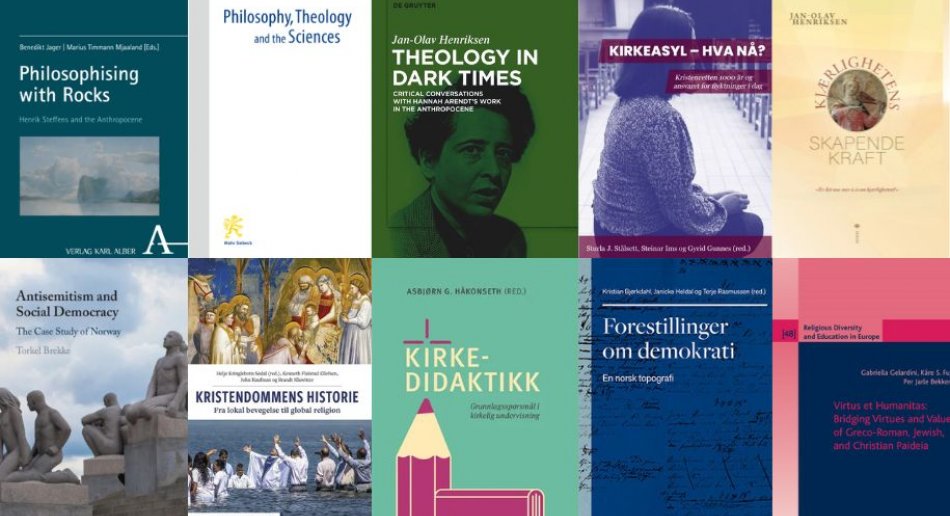
Publications from MF reserachers
Published: 23. September 2026
Through books, book chapters, and scholarly articles, researchers at MF contribute to new knowledge and academic dialogue, both nationally and internationally. Here is a selection of publications from recent times.

Writing and teaching Contested History
Published: 17. July 2026
As competing memories meet official narratives in the classroom, the question becomes not only what history is taught, but whose stories are told.

An Overlooked Part of Europe’s Intellectual History
Published: 24. April 2026
A central part of Europe’s intellectual history has long been overlooked, says Doctoral Research Fellow Zeshan Ullah Qureshi.
– Europe has not only imagined Islam. It has read, translated, and interpreted the Qurʾān for nearly a thousand years.

What Makes Engagement Truly Meaningful?
Published: 30. March 2026
Volunteering is often celebrated as a force that strengthens communities, nurtures solidarity, and fills societal gaps. But what actually happens to individuals when they begin volunteering?